Why They’re Great
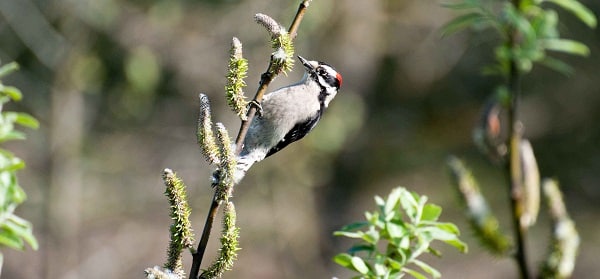
As natural predators, downy woodpeckers have proven to be huge assets in the fight against destructive and invasive insects like the Elm Bark Beetle, the Emerald Ash Borer, and the European Corn Borer. These insects do millions of dollars of damage every year, and we are lucky to have these small birds as allies! Like the northern cardinals, these birds are also much loved and protected by the Federal Migratory Bird Treaty Act.
Blue Jays
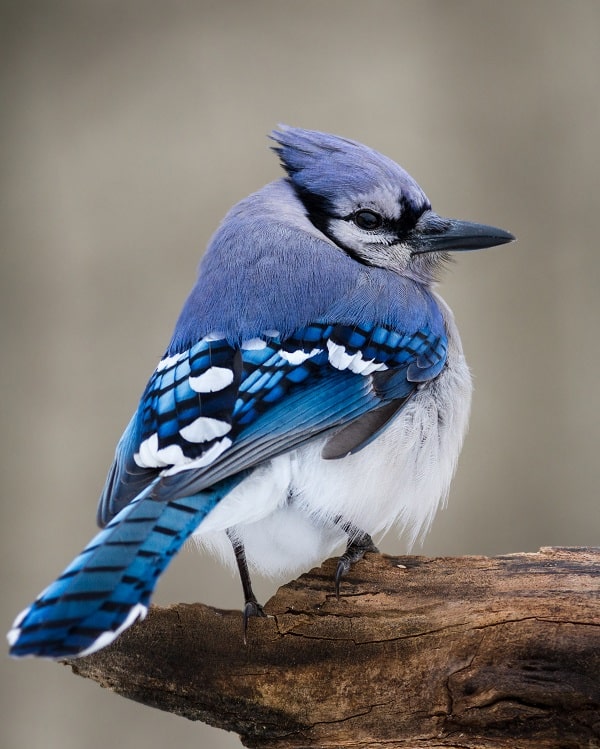
Another common yet interesting backyard wild bird is the blue jay. Although its feathers are white on its chest and underneath its body, the blue crest and overall blue color are unmistakable. Both males and females enjoy this blue color, and their colors stay the same all year round.
Blue jays are known for being noisy and aggressive and may bully other birds away from the feeder. However, they are a highly beneficial addition to any backyard, as they will also be aggressive toward any invading predator like raptors, hawks, owls, or other dangers, so in many instances, they act as the protector for smaller birds. They can also mimic the loud call of a hawk, which may frighten other predators away and warn smaller birds of impending danger.
What They Eat
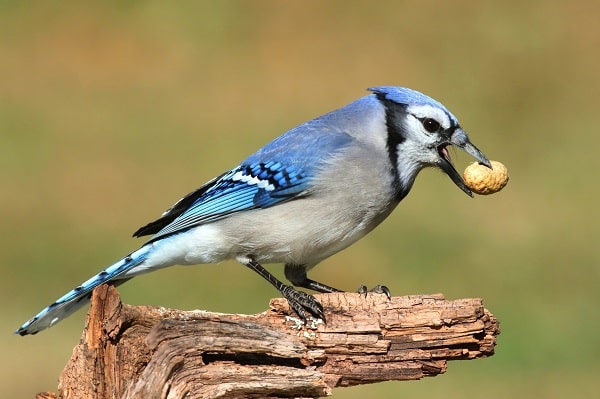
The strong bill of a blue jay allows them to open nuts and seeds with ease, including acorns, peanuts, or other seeds with tough shells. They can eat from feeders or from the ground and are not incredibly picky eaters. Besides nuts and seeds, they also like to eat grains, fruits, berries, bits of bread or meat, corn, and even human table scraps.
White-Breasted Nuthatch

While not very colorful, these small and adorable wild birds are extremely acrobatic and actually prefer to be upside down! They have a distinctive and streamlined shape, which makes them easy to spot as they slide up and down headfirst along tree trunks. They usually forage for food, starting from high up in the treetops and making their way down.
These nuthatches are common to backyards and will store sunflower seeds from feeders and suet cakes in their bills for later storage in nooks and crannies in tree bark or under bits of lichen or moss. So while they appear to be digging for insects like a woodpecker, they might just be collecting some of their earlier treasures. They do feed mainly on insects (and spiders in particular), and exclusively make this the diet of their babies.
Female nuthatches are solely responsible for nest building and usually make their nests in abandoned woodpecker holes 15-60 feet high for safety. Before building a nest, she will often coat the inside of the cavity with a dead insect’s secretions to chemically ward off predators. She lines the cavity with clumps of mud, bark, and fur as a base, then builds a softer, smaller nest on top. It’s a lot of work, but she’ll use the same nest for years.
Many interesting species of wild birds have learned to cohabitate with humanity and can often be seen courting, nesting, and feeding in backyards, parks, and urban and rural spaces. Not only do they play a vital role in our natural ecosystem, but their behaviors and songs are also fascinating to observe.